Automated workstations have become an indispensable part of modern industries, streamlining operations, increasing efficiency, and enhancing precision. As a leading supplier of automated workstations, I often get asked about the hardware components required to build a high – performance automated workstation. In this blog, I’ll delve into the key types of hardware needed for such workstations, providing insights that will help you make informed decisions for your automation needs. Automated Workstations
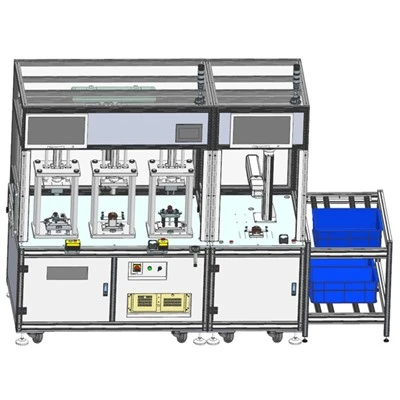
1. Controllers
Controllers are the brain of an automated workstation. They are responsible for managing and coordinating all the other hardware components. Programmable Logic Controllers (PLCs) are commonly used in industrial automated workstations. These are rugged and reliable devices that can handle a wide range of input and output signals, making them suitable for controlling everything from simple conveyor belts to complex robotic arms.
PLCs can be programmed using ladder logic, function block diagrams, or other programming languages. They allow for easy configuration and modification of the control algorithms, enabling quick adjustments to the automated processes as needed.
Another type of controller often used in automated workstations is the Industrial PC (IPC). IPCs offer more computing power than PLCs and are capable of running complex operating systems and software applications. They are ideal for tasks that require high – level data processing, such as vision inspection systems or data analytics related to the automated processes. IPCs can be integrated with other hardware components through various interfaces, ensuring seamless communication and control.
2. Actuators
Actuators are the muscle of an automated workstation. They are responsible for converting electrical, hydraulic, or pneumatic energy into mechanical motion. One of the most common types of actuators used in automated workstations is the electric motor. Electric motors come in different types, such as DC motors, AC motors, and stepper motors.
DC motors are known for their simple control and high starting torque, making them suitable for applications where variable speed and quick acceleration are required. AC motors, on the other hand, are more efficient and reliable for continuous – operation applications. Stepper motors are precise and can be controlled to move in discrete steps, which is ideal for applications that require accurate positioning, such as 3D printers or pick – and – place robots.
Hydraulic and pneumatic actuators are also widely used in automated workstations. Hydraulic actuators can generate high forces and are suitable for heavy – duty applications, such as large – scale manufacturing or construction equipment. Pneumatic actuators are lightweight, fast – acting, and relatively inexpensive, making them a popular choice for applications where rapid movement and moderate force are needed, such as assembly line operations.
3. Sensors
Sensors are the eyes and ears of an automated workstation. They are used to detect and measure various physical quantities, such as position, temperature, pressure, and proximity. By providing real – time feedback to the controller, sensors enable the automated workstation to make intelligent decisions and adjust its operations accordingly.
Position sensors are crucial for ensuring accurate movement and positioning of the actuators. Encoders, for example, can measure the rotation or linear displacement of a motor shaft, providing precise position information to the controller. Proximity sensors are used to detect the presence or absence of objects, which is useful for tasks such as object detection in a conveyor system or collision avoidance in a robotic arm.
Temperature sensors can monitor the temperature of components such as motors, controllers, or workpieces. This is important for preventing overheating and ensuring the reliable operation of the automated workstation. Pressure sensors are used to measure fluid pressure in hydraulic or pneumatic systems, allowing for proper control and monitoring of these systems.
4. Power Supplies
A reliable power supply is essential for the proper functioning of an automated workstation. Power supplies need to provide stable voltage and current to all the hardware components. In industrial environments, the power supply must be able to withstand electrical noise, voltage fluctuations, and other harsh conditions.
Uninterruptible Power Supplies (UPS) are often used in automated workstations to protect against power outages. A UPS can provide backup power for a short period, allowing the workstation to shut down properly and prevent data loss or damage to the hardware.
Switch – mode power supplies are commonly used in automated workstations due to their high efficiency and compact size. They can convert the input AC voltage to the required DC voltage for the various hardware components, such as controllers, sensors, and actuators.
5. Mechanical Structures
The mechanical structure of an automated workstation provides the physical support and framework for all the other hardware components. It must be designed to be rigid, stable, and durable to ensure accurate and reliable operation.
Frames and enclosures are used to house the hardware components and protect them from external factors such as dust, moisture, and mechanical damage. They can be made of various materials, such as steel, aluminum, or plastic, depending on the specific requirements of the application.
Linear guides and ball screws are often used in automated workstations to provide smooth and precise linear motion. They allow the actuators and other moving components to move accurately along a straight path, which is essential for tasks such as pick – and – place operations or precision machining.
6. Communication Interfaces
Automated workstations often need to communicate with other devices, such as computers, servers, or other automated systems. Communication interfaces are used to enable this data transfer.
Ethernet is a widely used communication interface in automated workstations. It provides high – speed data transfer over a network, allowing the workstation to communicate with other devices in real – time. Ethernet can also be used for remote monitoring and control of the automated workstation.
Other communication interfaces, such as USB, RS – 232, and CAN bus, are also commonly used in automated workstations. USB is useful for connecting peripheral devices, such as keyboards, mice, or external storage devices. RS – 232 is a serial communication protocol that is often used for legacy devices or for communication over short distances. CAN bus is a robust communication protocol that is commonly used in automotive and industrial applications for reliable data transfer between multiple devices.
Conclusion
Building an effective automated workstation requires a careful selection of hardware components. From the controllers that manage operations to the sensors that provide feedback, each component plays a crucial role in the overall performance of the workstation.
As a supplier of automated workstations, I understand the importance of providing high – quality hardware that meets the specific needs of each customer. Whether you are looking to automate a simple assembly line or a complex manufacturing process, I can help you select the right hardware components and design a customized automated workstation.
Marine Equipment If you are interested in learning more about our automated workstations or would like to discuss your specific requirements, feel free to reach out. I am committed to providing you with professional advice and solutions to optimize your automation processes.
References
- Madisetti, Vijay K., and Janak H. Patel, eds. Handbook of Industrial Automation. CRC Press, 2000.
- Dorf, Richard C., and Robert G. F. Nof, eds. The Industrial Automation Handbook. Wiley – Interscience, 1999.
- Craig, John J. Introduction to Robotics: Mechanics and Control. Pearson, 2004.
Ningbo Autino Automation Equipment Co., Ltd.
As one of the most professional automated workstations manufacturers and suppliers in China, we also support customized service. We warmly welcome you to buy advanced automated workstations from our factory. If you have any enquiry about quotation, please feel free to email us.
Address: No.555 Beichuan Road, Jiangbei District, Ningbo City, Zhejiang Province, P.R. China
E-mail: sales@autino.cn
WebSite: https://www.autinotech.com/
